Restaurant Website Design and Digital Services: What Your Business May Need
A practical overview of web design, e-commerce, SEO, maintenance, branding and content services for restaurants.
Why a restaurant website still matters
A menu directory can help customers discover food, but a restaurant website can become the business's central online home. It can explain the brand, show the menu, provide directions, collect inquiries, promote catering and events, and connect customers to ordering or reservation services.
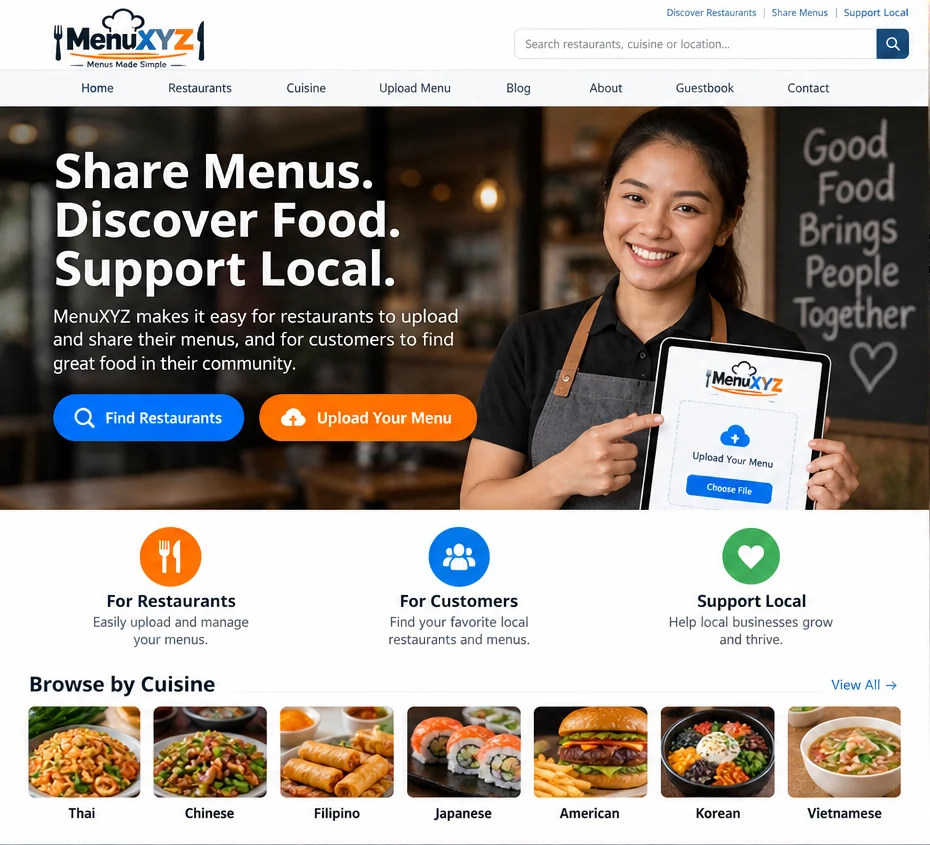
MenuXYZ is expanding its restaurant-focused services around that reality. The service categories are based on common digital needs, including web design, e-commerce connections, SEO optimization, maintenance, branding and content. The purpose is to give restaurant owners a practical way to think about the entire digital presence rather than treating the menu as an isolated file.
Website design
Good design starts with the customer's next action. A restaurant site may need a prominent menu button, a phone link, directions, online ordering or reservations. It also needs clear information about hours, location and cuisine. Mobile responsiveness is essential because many visitors will arrive from a phone.
A custom design can reflect the restaurant's colors, photography, logo and personality. The goal is not to make every page complicated. It is to create a clear hierarchy and a consistent visual system that makes information easy to find.
E-commerce and ordering connections
Restaurants can use websites to sell more than meals at a table. Catering packages, gift cards, merchandise and prepared food may be sold online. A restaurant may also use a third-party ordering or reservation platform.
MenuXYZ can help organize links and customer flow, but third-party providers remain independent. Their fees, checkout processes, privacy practices and availability are controlled by them. Restaurant owners should review those terms before using a provider.
SEO optimization
Search optimization is about making useful information understandable to search engines and customers. A restaurant site can use clear page titles, headings, location information, menu content, image descriptions and internal links. A blog can answer questions that customers actually ask.
SEO is not a guarantee of rankings. Search engines change their systems, competitors publish content and local results depend on many factors. A responsible service focuses on useful content, technical quality and accurate information.
Website maintenance
Restaurant websites change frequently. Menus change. Hours change. Seasonal promotions appear. Ordering links change. A maintenance service can help with content updates, broken links, backups, software updates and security checks.
Maintenance is also a good time to review accessibility. Headings, contrast, keyboard navigation, labels and alternative text should remain usable as pages evolve.
Branding and content
A restaurant's logo and visual identity can be used across the website, menu, social media and printed materials. Content can include dish descriptions, the restaurant story, catering information, FAQs and blog articles. The business should only use photographs, logos and written material it has the right to use.
A simple package of services
Restaurants do not always need every digital service at once. A small business might start with a five-page website and a menu page. Later, it may add online ordering, SEO content, a blog, catering forms or ongoing maintenance. A larger restaurant group may need multiple locations and more complex integrations.
MenuXYZ's approach is to keep the process understandable. Start with the customer journey, identify what the restaurant needs, and add services that solve a real problem. Where a third party is needed, make that relationship clear.
How MenuXYZ fits
MenuXYZ can be the menu-discovery layer, the restaurant website can be the primary brand home, and third-party platforms can provide specialized ordering or payment functions. The restaurant remains responsible for its own business information and compliance obligations.
If you are ready to review your restaurant's digital presence, visit Website & Digital Services or contact MenuXYZ.
Start with a discovery conversation
A website project should begin with questions, not a template. What does the restaurant want customers to do? What information changes most often? Does the restaurant have multiple locations? Is catering important? Does it need online ordering? Who will provide photos and text? Who will maintain the website after launch?
Answering those questions helps prevent a site from becoming a collection of attractive pages without a clear purpose. A small restaurant may need a simple five-page site, while a restaurant group may need location management and more advanced integrations.
Plan the page structure
Most restaurant sites benefit from a small set of clear pages: Home, Menu, About, Location/Contact and one or more service pages such as Catering or Events. Additional pages can be added when they answer a real customer question. The navigation should remain simple on both desktop and mobile.
Use the menu as a core conversion point
Visitors often arrive specifically to see the menu. The menu button should therefore be easy to find. If the restaurant has multiple menus, label them clearly by location, meal period or purpose. If a menu is seasonal, show the current date or season when useful.
Build with performance in mind
Restaurant websites often use large photographs, videos and social embeds. These can make the site attractive but can also slow it down. Compress images, use responsive sizing and avoid unnecessary scripts. A fast website is easier to use on mobile connections and can reduce abandonment.
Connect e-commerce carefully
If the restaurant sells gift cards, merchandise or catering packages, the website can act as the storefront while a third party handles checkout. This can reduce development work, but it also creates a dependency. The restaurant should understand the provider's fees, refund rules, privacy terms and customer-support process.
Build an SEO content foundation
SEO starts with clear information. Each important page should have a useful title and heading structure. The restaurant name, city, cuisine and relevant services should be presented naturally. Blog articles can answer customer questions and support discovery. Technical SEO can also include performance, crawlability, canonical URLs, image alternative text and structured data where appropriate.
There is no ethical shortcut that guarantees a specific ranking. A website should be built for people first, with search visibility as an important secondary goal.
Maintenance plans should be specific
“Maintenance” can mean different things. A good agreement should identify whether maintenance includes content edits, menu updates, backups, software updates, security monitoring, link checks, hosting, domain management or emergency support. This makes the service easier to understand and prevents assumptions.
Branding should remain consistent
Menus, websites, signs, social media and email should feel like the same restaurant. Consistent colors, typography, photography and logo use make the business easier to recognize. If the restaurant does not yet have a consistent visual identity, branding support can create a foundation before the website is built.
Content ownership matters
Restaurants should know which materials they own and which are licensed. A project agreement can specify ownership of custom graphics, photographs, copy and code. Third-party themes, fonts, stock photos and plugins may have separate licenses. MenuXYZ should not promise ownership of material that is controlled by a third-party license.
Accessibility should be part of the project
Accessibility should be considered during design and testing. Use proper headings, readable contrast, keyboard access, labeled forms, descriptive links and appropriate alternative text. The legal obligations depend on the business and jurisdiction, but accessible design is a practical way to reduce barriers.
Security should be planned
Security can include HTTPS, strong administrator credentials, limited access, software updates, backups and careful third-party integrations. No provider can guarantee zero risk. A good maintenance plan focuses on reducing common risks and preparing for recovery.
When third parties are involved
Many restaurant websites depend on independent providers. MenuXYZ may coordinate with or link to those services, but it does not have legal control over them. The restaurant should have its own accounts where practical, retain access to domains and important services, and understand recurring costs.
A simple growth path
A restaurant can start with MenuXYZ and a simple website, then add services as the business needs them. A sensible path might be: menu and contact information first; professional website second; SEO and content third; ordering or catering connections fourth; ongoing maintenance fifth. This keeps the project manageable and gives the restaurant time to learn what customers actually use.
Choose services based on the restaurant's stage
A new restaurant may need branding, a basic website and menu presentation. An established restaurant may need SEO, online ordering, catering forms and maintenance. A multi-location restaurant may need location pages and centralized content management. Services should match the business rather than forcing every restaurant into the same package.
Ask what happens after launch
A website is only useful if someone can keep it current. Before a project begins, decide who will make menu changes, who will update hours, who will add promotions and who will respond to technical problems. A maintenance service can provide that support when the restaurant does not have an internal person.
Understand recurring third-party costs
Domains, hosting, email, payment processing, ordering platforms, reservation systems, premium plugins and advertising services can create recurring costs. A good project should identify those costs separately so the restaurant knows what it will continue paying after the initial website build.
Keep ownership organized
The restaurant should retain access to its domain and important business accounts. If a website provider registers a domain on behalf of a client, the agreement should clarify ownership and how the account can be transferred. This reduces the risk of losing control if the relationship ends.
Use a realistic content plan
Restaurants often have limited time for writing. A practical plan might include a small number of evergreen pages plus occasional seasonal updates. The website does not need hundreds of pages. It needs useful pages that stay accurate.
Review performance and accessibility
After launch, test page speed, mobile layout, forms, keyboard navigation and image text alternatives. If a third-party integration changes, retest the customer journey. Maintenance is an ongoing quality process, not just a technical repair service.
Keep the customer journey simple
The most important question remains: can a customer quickly understand the restaurant and take the next step? MenuXYZ, the restaurant website and third-party services should work together to answer that question. If a feature adds complexity without helping the customer, it may not belong on the page.
Review the project in phases
Restaurants can reduce complexity by treating digital improvements as phases. First establish the core website and menu. Then improve discovery and SEO. Next connect ordering or e-commerce if needed. Finally establish maintenance and measurement. This phased approach lets the restaurant learn from customers before adding more technology.
Keep a simple service record
Maintain a list of domains, hosting accounts, third-party providers, renewal dates and responsible contacts. This information is useful when a website needs an urgent change or a provider relationship ends. It also reduces the risk of a restaurant losing access to a critical account.
Ask for clear deliverables
A website project should state what is included, what is not included and how changes are handled. Clear deliverables help both the restaurant and service provider understand expectations. For third-party services, the agreement should identify whether MenuXYZ is merely providing a link or is actually coordinating an integration.
Keep the final experience simple
Technology should serve the restaurant rather than become the restaurant's burden. A clear menu, professional website, accurate local information and dependable maintenance can provide a strong foundation. Additional features should be added when they solve a real customer or business need.
Document who handles each service
If a project uses several providers, document who handles the website, domain, hosting, ordering, payments, SEO and content. Clear responsibilities make troubleshooting easier and help the restaurant retain control over its digital presence. MenuXYZ can help organize the customer journey while independent third parties may handle specialized functions.